

Homeless Education
Collaborative

chalkboard with books stacked next to it

Advancing educational equity for students experiencing homelessness and in foster care

People Serving People’s Homeless Education Collaborative is a network of stakeholders across Minnesota working at the intersection of education and homelessness to improve outcomes for students experiencing homelessness and those in foster care.

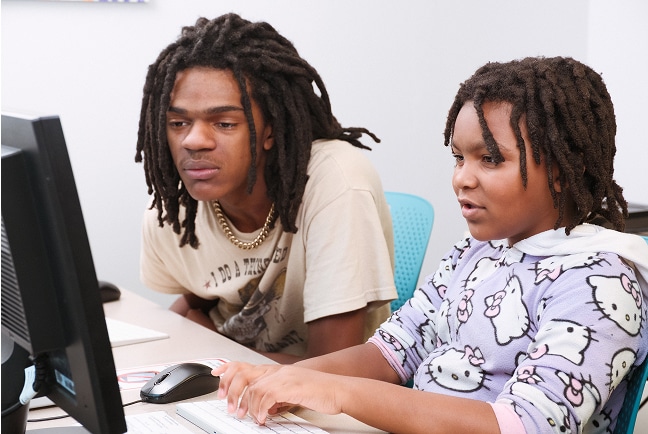
Two kids look at a computer screen; one uses the mouse while the other observes closely.

The work of the collaborative

Students experiencing homelessness and those in foster care face systemic barriers that hinder their academic success, including housing instability, disrupted learning experiences, limited coordinated support systems, and decisions made without the voices of impacted students and families at the center.

Minnesota is uniquely positioned to make significant progress toward improving outcomes for students experiencing homelessness and those in foster care. The local landscape includes a mix of innovative practices and policies for students, yet also has markedly poor student outcomes and a dramatic gap in the training and support needed.  
The Homeless Education Collaborative works statewide to strengthen systems and improve student outcomes through:

  • Training and technical assistance for school district homeless liaisons
  • Collaboration with the Minnesota Department of Education and community partners
  • Policy and systems change advocacy
  • Cross
  • Cross-sector partnerships connecting education, housing, and community services
  • Centering lived experience in decision making 

Minnesota Student Homelessness Data

According to the National Center for Homeless Education’s Report, the “Education of Children and Youth Experiencing Homelessness in the United States: Data Summary for School Years 2021-2022 to 2023-2024, children and youth experiencing homelessness in Minnesota and in the country is drastically on the rise. Nationwide, it increased by 28.5% in just three years. Minnesota data points are included here.

  • 42% increase

    in student homelessness since SY 2019-2020 (reaching the highest level recorded in the state data series)

  • 18,886 pre-K students

    identified as experiencing homelessness in SY 2023-2024 representing 2.2% of enrollment (national average is 3.2%)

  • 17.8% are unaccompanied youth

    of the 18,886 students experiencing homelessness, 3,353 were indentified as unaccompanied (more than double the national average of 8.3%)

children's arms with bracelets on them putting their hands together in a circle

State Student Homelessness Project

Improving educational outcomes for students experiencing homlessness

The National Conference of State Legislatures (NCSL),  SchoolHouse Connection, and the National Center for Youth Law (NCYL) are partnering with Alabama, Indiana, and Minnesota to strengthen policies and practices that support K–12 students experiencing homelessness. These national organizations will provide cross-sector leadership, convening, and technical assistance, with the first in-person convening September 14-17, 2026, in Seattle.  

Through the State Student Homelessness Project, Minnesota is developing a statewide cross-sector partnership focused on improving educational outcomes for students experiencing homelessness. People Serving People serves as Minnesota’s State Lead, bringing together stakeholders from education, policy, advocacy, and community organizations to align priorities, set shared goals, track progress, and strengthen systems that promote long-term student success.   

Over the next two years, national and state partners will collaborate to expand knowledge, build statewide capacity, and develop a sustainable action plan to improve outcomes for students experiencing homelessness.  

A woman with long brown hair smiles outdoors, wearing a striped jacket and a chunky black necklace.

“Experiencing homelessness is one of the strongest predictors of not graduating high school—and not graduating high school is one of the strongest predictors of adult homelessness.”

Charlotte Kinzley – Chief Program Officer, People Serving People

How the Collaborative creates impact

Short-term impact

  • Increased knowledge and skills among homeless liaisons statewide
  • Greater awareness among policymakers of student needs and service gaps
  • Statewide implementation of best practices
  • Stronger policies and supports for students and families

Long-term impact

  • Higher attendance and engagement
  • Improved academic performance and graduation rates
  • More equitable education outcomes for students experiencing homelessness and foster care

Interested in learning more?

Please reach out to Amy Riccio, Homeless Education Collaborative Director, at ariccio@peopleservingpeople.org.